
One sample or a batch, with context intact
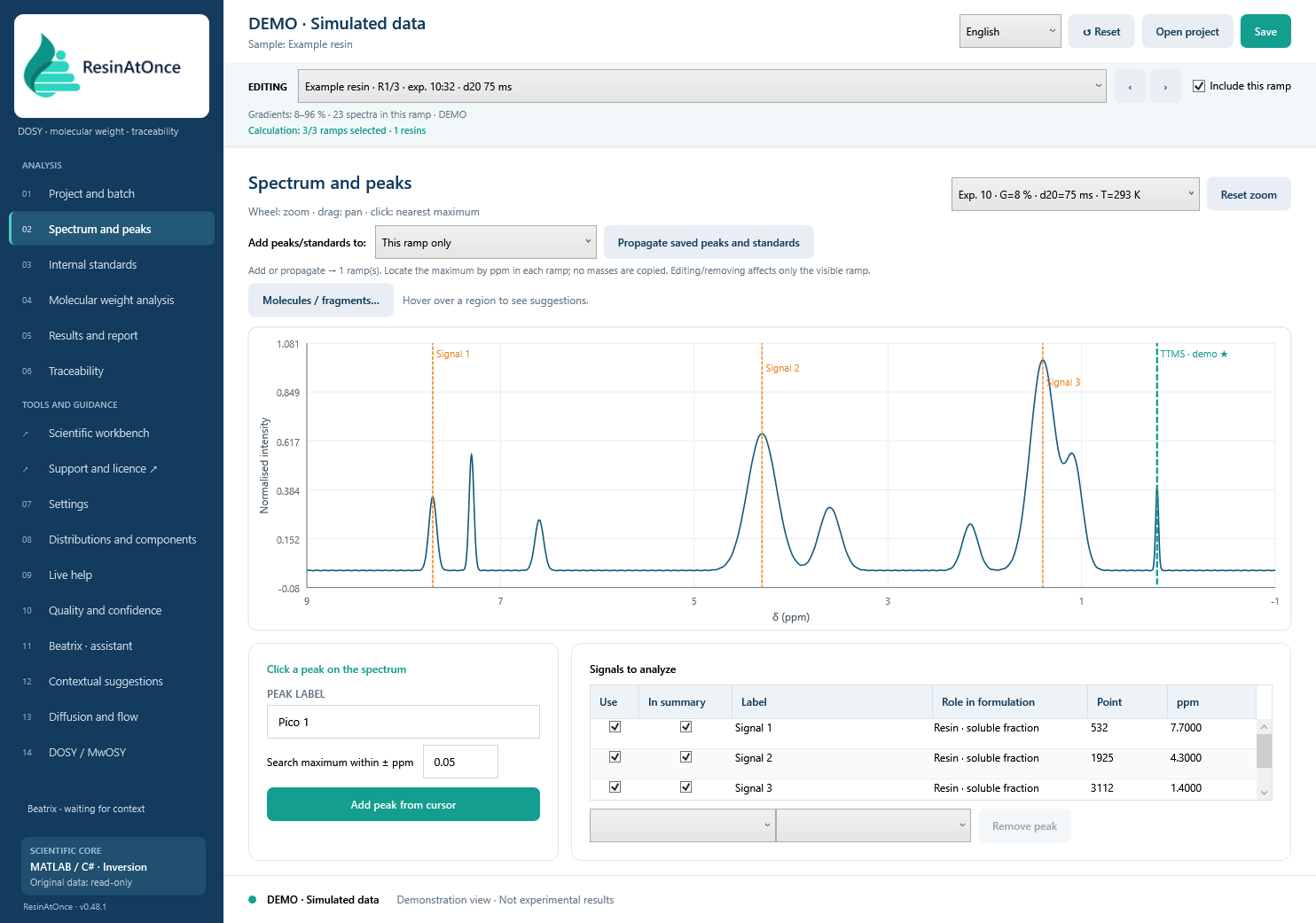
Read Bruker acquisitions, review spectra and ramps, select signals in ppm and retain each sample’s gravimetric preparation. Distinguish resin signals, reactive diluents, additives, impurities and solvents: not every peak represents the polymer distribution.
Diffusion with optional standards
Review probe, sequence, gradient and temperature. Use one or several reviewed internal standards, or calculate D without an internal standard with explicit labelling. Reference and thermal factors are retained, without duplicate temperature correction.
Two systems for apparent mass conversion
PS and PPG are the two high-dilution curves. The shared empirical concentration model was developed with PS; it is not a second concentration calibration specific to PPG. Concentration is solute mass / solvent mass in mg/mg. Transfer to other families and branched architectures requires review.
DOSY/MwOSY, from data to bands
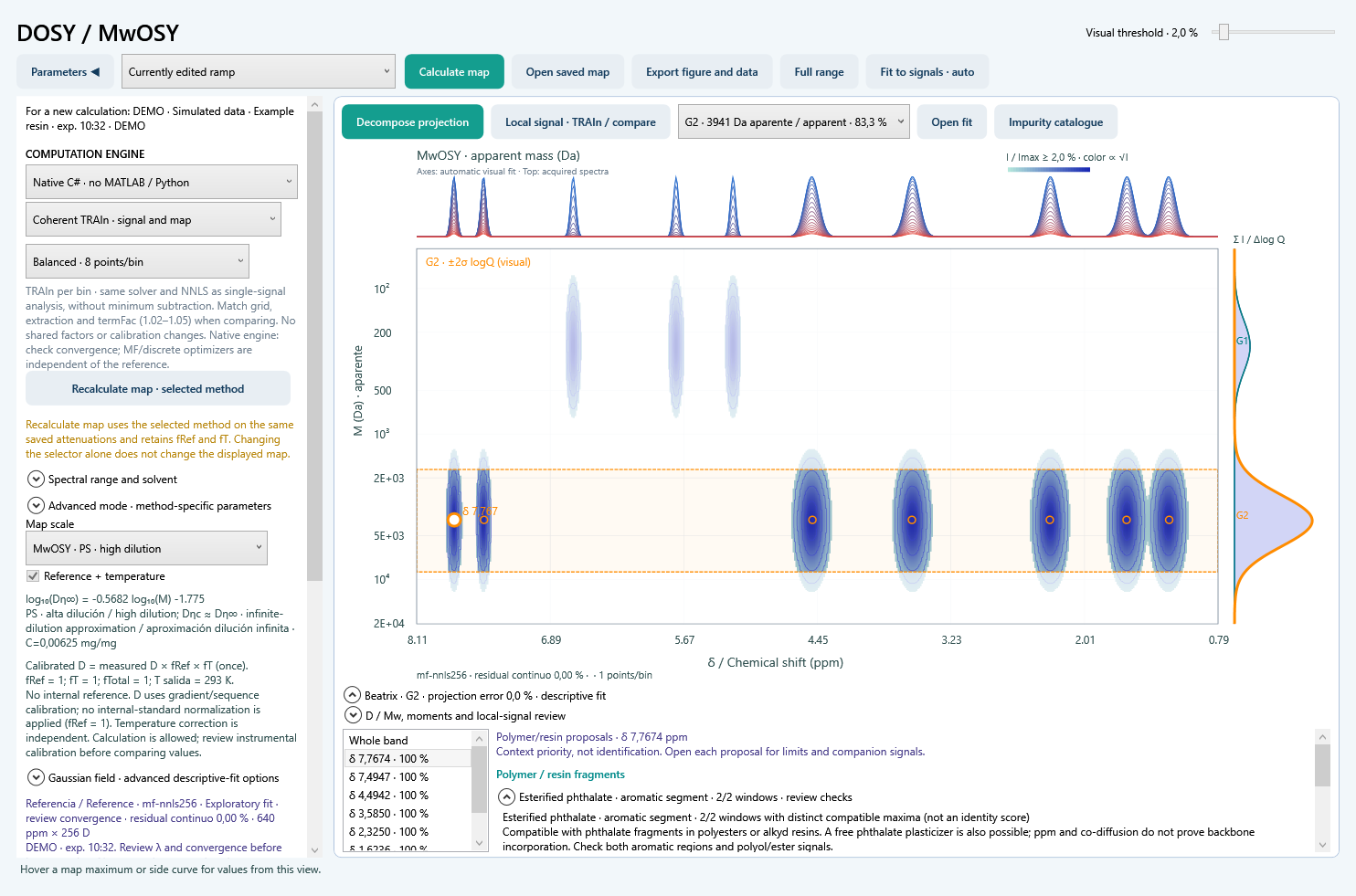
Maps of ppm against D or apparent mass, with spectra above and a lateral projection. Native C# methods include per-bin TRAIn, historical TRAIn-MF, MF-NNLS256, RAI-S, DOME-S and SILT-DOSY, with advanced parameters and attenuation checks.
Automatic axis fitting, visual threshold, Gaussian field with preservation of unfitted signal and decomposition of the active projection. Select bands and cross peaks to inspect D/Mw, moments and, where applicable, Rh and dispersity. Gaussian representation is descriptive; its components are not demonstrated chemical species.
Convection: diagnosis is not correction
Review whether evidence is compatible with convection, no convection is detected in the check, or the diagnosis is inconclusive. Inspect phase, residuals and stability across ramps.
A convection-free control from the same preparation allows final results and the report to be recalculated from that acquisition, with explicit provenance. Physical inversion of the convective signal is a separate route, subject to its requirements. Forcing a result does not resolve a blocker, and a blocker does not prove absence of convection.
Beatrix, focused on resins and polymers
Contextual help in application windows and documented suggestions for spectral regions, DOSY/MwOSY bands and cross peaks. Polymer/resin fragments are distinguished from diluents, additives and impurities, with nucleus, solvent and companion-signal checks.
Candidates are hypotheses, not automatic identifications. Documentary help works without local inference; LLM queries require a configured model. Beatrix does not independently change calculations, standards or results.
Results and reports with provenance
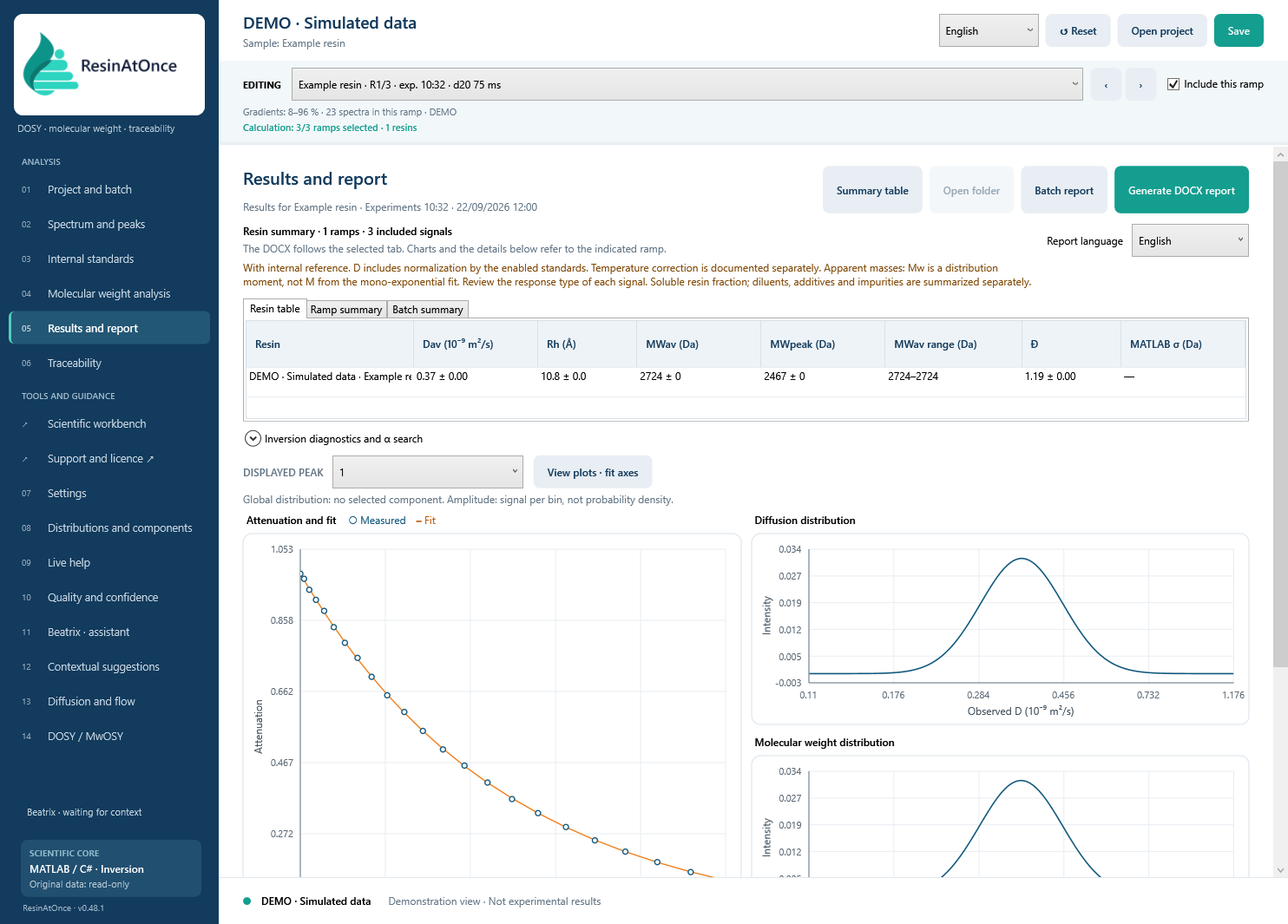
Diffusion, hydrodynamic radius, apparent masses and moments are presented with their conditions. Review the report scope —resin, ramp or batch— and export DOCX in English or Spanish. Revisions and use of a control acquisition remain separate from original data.
Version and availability
This presentation and its screenshots describe ResinAtOnce 0.50.1, a 64-bit Windows WPF application. The native C# and C# API engines run the included methods locally; the MATLAB engine requires its compatible environment. Local Beatrix models need additional resources.
Current distribution is unchanged. This website update does not enable a new public download or change licence terms.
Scientific limits
Research software. A good fit does not validate a distribution, absolute absence of convection or chemical assignment. Co-diffusion does not prove identity. Linear-polymer calibrations do not certify absolute masses of stars, brushes or branched resins. The DEMO guide uses simulated data; archived experimental views are labelled separately.
Shared audit and local comparison
ResinAtOnce 0.48.1 shares Prime 0.12.5’s local TRAIn core and checks for inputs, cancellation, selection state, molecular segment changes and atomic JSON saving. Compare the same region with identical parameters: a global-projection band is not a peak distribution.
The guide includes recovery steps and limitations. Regression tests are software checks, not experimental validation of every resin or quantitative concentration estimates for overlapping compounds.
ARCHIVED EXPERIMENTAL CASE
A real resin, with its saved context.
TP194, ¹H/CDCl₃. Experimental result saved on 26 Sep 2026 and displayed in ResinAtOnce 0.48.1: archived per-bin TRAIn inversion, without reinversion. The Gaussian display field and active projection were recalculated in memory. fReference = 0.856757539; fTemperature = 0.999026783; output at 293 K.
These saved cases have their own extraction, parameters and factors; they are not a numerical comparison between applications. To compare Prime and ResinAtOnce, match signal, b, grid, method, parameters and corrections. Data were not modified or values forced to agree.
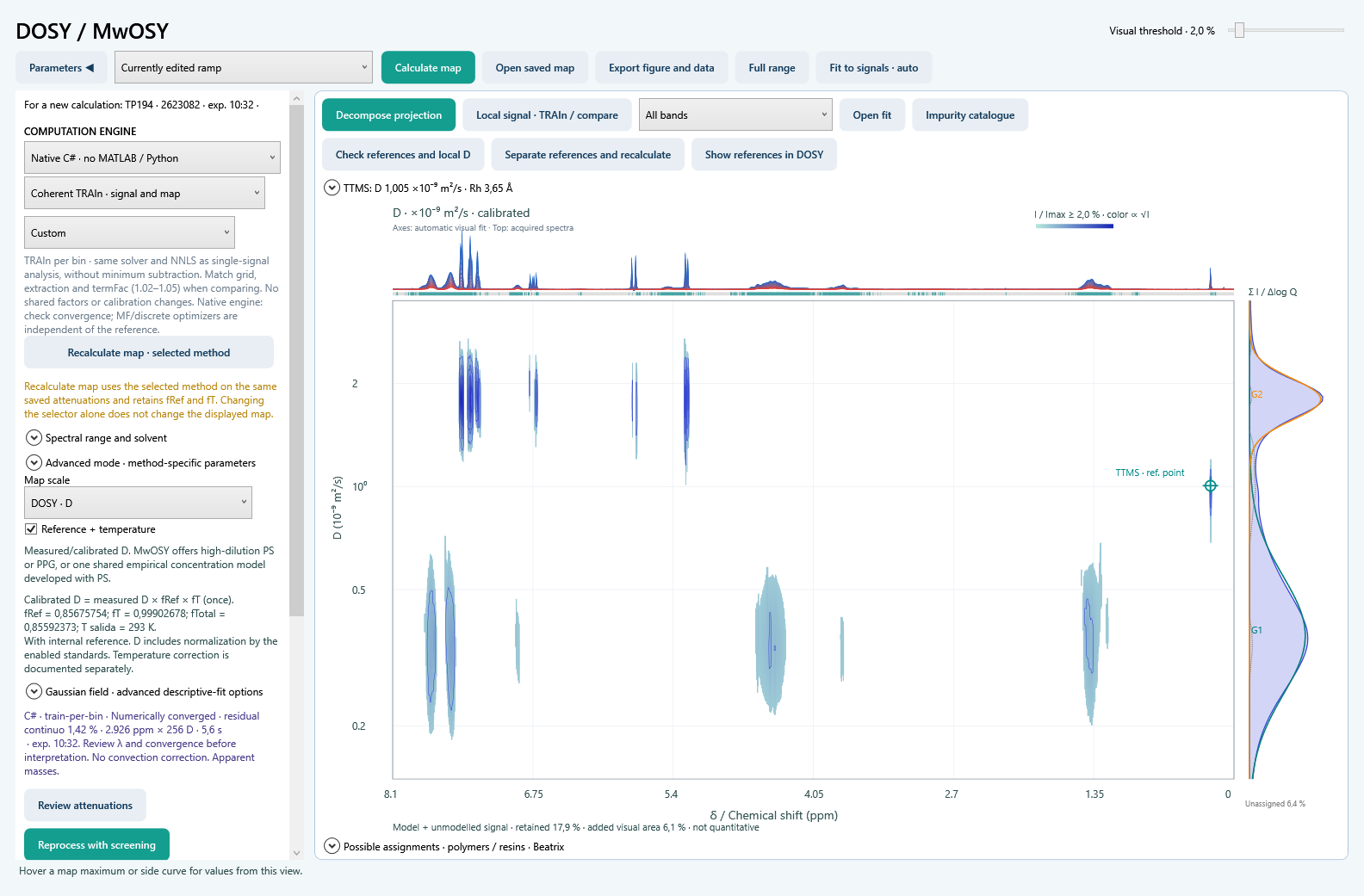
Archived experimental data; actual interface capture. Hypotheses and apparent mass require review.
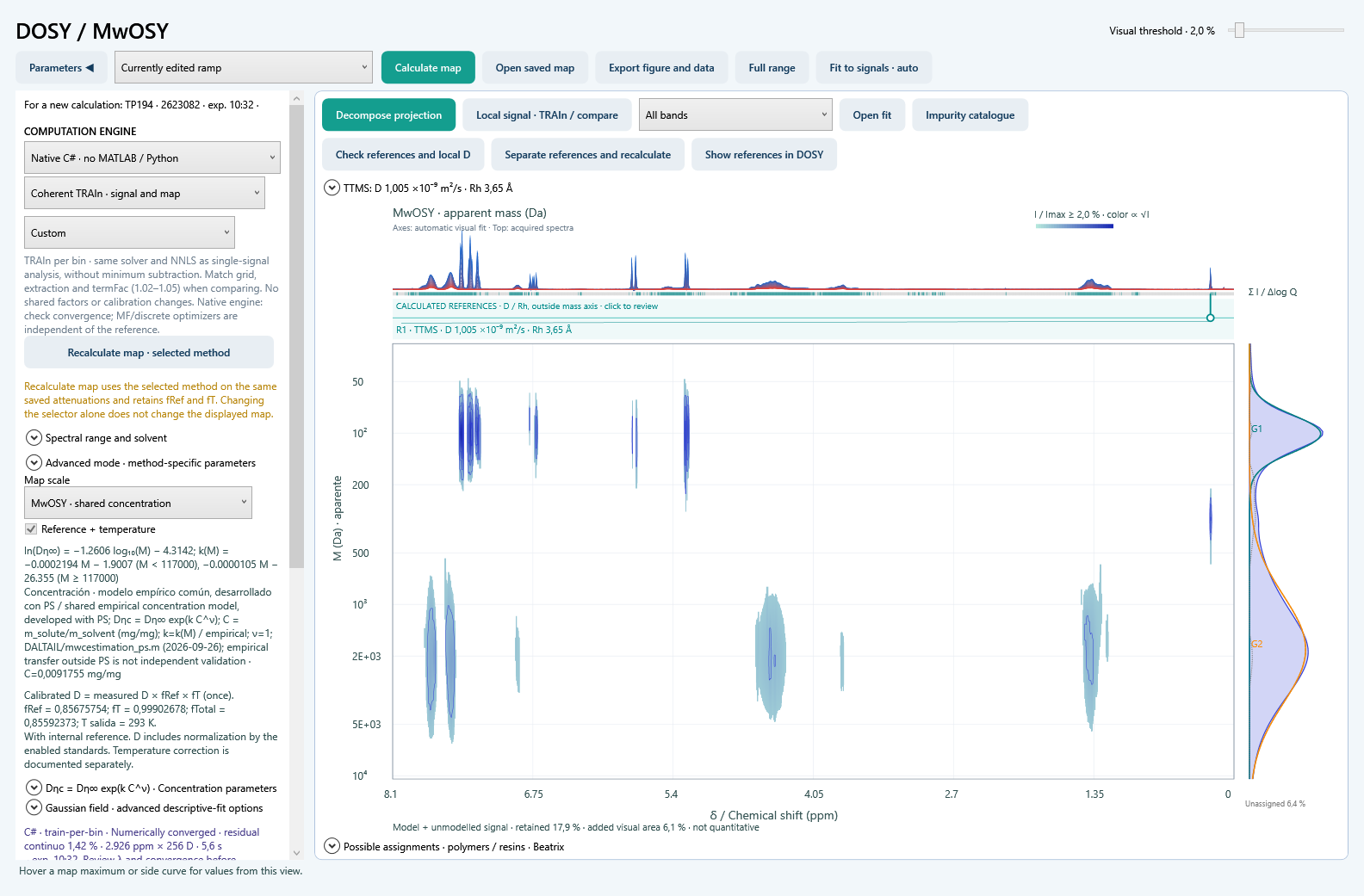
Archived experimental data; actual interface capture. Hypotheses and apparent mass require review.
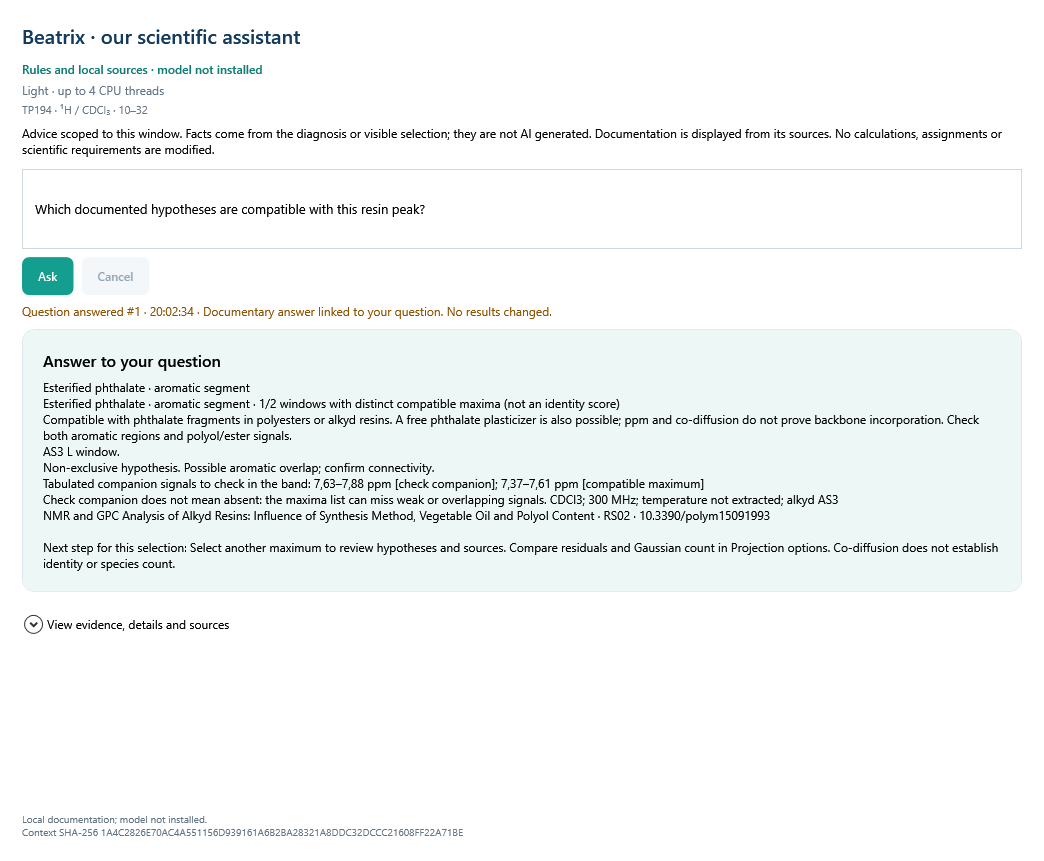
Archived experimental data; actual interface capture. Hypotheses and apparent mass require review.
Archived-case settings: train-per-bin algorithm, legacy-amplitude protocol, 16-point spectral binning and 256 D bins. MwOSY uses the shared empirical concentration model developed with PS and archived C = 0.0091755 mg/mg. These settings belong to that result; they are not transferred to another preparation.