FUNPOLYMER · Diffusion NMR and artificial intelligence

DiffAtOnce: diffusion NMR and artificial intelligence for polymer molecular weight

Molecular weight prediction in any solvent and at any concentration*

DiffAtOnce is a platform developed within the FUNPOLYMER project to process diffusion NMR experiments and estimate polymer molecular-weight distributions. It combines Arrabal–Fernández scaling, universal calibration, advanced numerical algorithms, inverse Laplace transforms and artificial intelligence.

* Solvent and concentration independence through a calibrated model. The 2025 paper studies linear, low-dispersity PS and PPG and concentrations from 1.5 to 150 mg/mL. Extrapolation to other systems requires reviewing calibration and applicability. Paper and conditions ↗

FUNPOLYMER PID2021-126445OB-I00UNIVERSIDAD
DE ALMERÍA
INSTITUTE OF PHYSICAL CHEMISTRYPolish Academy of SciencesTeam and collaborations ↗

CURRENT FEATURES · REVIEWED HELP

Applications and learning: know their current status.

Prime 0.15.121 · ResinAtOnce 0.51.116 · Studio 0.1.7 · Academy 1.3.1 · Help reviewed 20 November 2026

Molecular D prediction

Choose one of 253 molecules or enter a new SMILES string. View the 2D structure alongside D. The calculation and the ¹H spectral library work offline, including in long Windows installation paths. Prime and ResinAtOnce calculate the diffusion coefficient at the selected temperature and in the selected solvent using the same catalogue as the web app.

Desktop visual guide

Follow the Studio, Prime and ResinAtOnce workflows using demonstration screens labelled with their version.

Open the illustrated guide →

Studio and WiX installers

Manage the suite from Studio: catalog, portable copies, Prime and ResinAtOnce MSI packages, integrity checks and confirmed updates. Downloading does not grant activation.

Current downloads and versions →

What does each MwOSY band represent?

Compare the global report with a breakdown of the stored projection. Check which maxima are observed, which bands are fitted only, and which masses should not be reported when a tail is missing.

Component export guide

Navigable batches

Every sample and ramp, global summary and selected detail. Save and reopen without recalculation.

TTMS by explicit decision

Signed points, manual review, reference archiving and permission to reuse only its factor with each destination’s own temperature.

Same figure, same values

Visible average attached as a retained snapshot; summary and full report share one review, without recalculating maps during export.

Visible limitations

Convection diagnosis, support and missing values explained. Research B23 and TabPFN are not presented as scientifically accepted methods.

Reviewed DOSY 2rr input

Declared shape and amplitude, lists and provenance: reading a matrix does not authorise inversion. Findings distinguish missing from conflicting information without inventing b.

D support and original projection

Automatic support for compatible native TRAIn, explicit manual bounds and stored axes remain distinct. Observed maxima, fitted-only bands and cut endpoints retain their evidence.

Older screenshots retain their version and provenance. Current public installers are identified on the Studio page; reading this help neither installs software, changes projects nor recalculates results.

FUNPOLYMER: from diffusion experiments to molecular-weight distributions

FUNPOLYMER addresses fast, traceable determination of molecular-weight distributions of polymers in solution by diffusion NMR, as an alternative to classical size-exclusion chromatography (SEC/GPC). Its central advance is to incorporate solvent and concentration dependence through the universal \( \kappa(M_w) \) and \( D\eta_{1/\infty}(M_w) \) curves.

The challenge

Reduce measurement time and solvent consumption, aiming to maintain or improve accuracy against SEC/GPC and move beyond the requirement to always work at very high dilution.

The objective is molecular-weight estimation independent of solvent and sample concentration, within the model’s applicability domain.

The solution

Integrate advanced ILT algorithms, universal calibration (UCC) and the \( \kappa(M_w) \) and \( D\eta_{1/\infty}(M_w) \) curves, alongside extended diffusion NMR (ediffNMR) and artificial intelligence.

One platform connecting experimental decays with diffusion and molecular-weight distributions that can be reviewed.

The outcome

DiffAtOnce: a research platform built around Arrabal–Fernández scaling and the universal curves developed within FUNPOLYMER.

This scientific foundation now supports five independent products: DiffAtOnce Legacy, DiffAtOnce DM, DiffAtOnce Continuum, DiffAtOnce Prime and ResinAtOnce.

Discover FUNPOLYMER · Methodological paper · European Polymer Journal (2025) · Equations and methodology

What DiffAtOnce provides

Numerical, physical and AI tools for the complete workflow, from diffusion acquisition to molecular-weight distributions and comparison with SEC/GPC. The model incorporates solvent and concentration effects instead of restricting analysis to a single experimental condition.

Specialised ILT algorithms

A library of inverse Laplace transform methods tailored to diffusion NMR: discrete and continuous approaches with advanced regularisation.

Method, grid and regularisation choices are part of the interpretation; fits and residuals should accompany the distributions.

Explore ILT methods

Solvent-independent universal calibration

Viscosity is treated as an explicit parameter. UCC and the \( \kappa(M_w) \) and \( D\eta_{1/\infty}(M_w) \) curves connect diffusion with molecular weight.

The scientific programme considers families including PS, PPG, PMMA, PE, dextran and polyisoprene. Calibration and supporting evidence are reviewed for each family; they do not all automatically share the same validation domain.

See the calibration model

Artificial intelligence and HPC

Deep learning and high-performance computing to accelerate large diffusion-NMR datasets and explore ultrafast and time-resolved methodologies.

Beatrix adds contextual help, scientific rules and documentary consultation in ResinAtOnce. These assistance functions are distinct from AI models dedicated to numerical reconstruction.

AI, ediffNMR and HPC architecture

Collaborations that connect science

Developed at the University of Almería within FUNPOLYMER (PID2021-126445OB-I00), in collaboration with the Institute of Physical Chemistry, Polish Academy of Sciences, Nuclear Hyperpolarization of Molecular Systems and Nanomaterials group.

The collaboration described by the project brings together Dr Tomasz Ratajczyk (group leader), Dr Mateusz Urbańczyk (main contact) and PhD student Marek Czarnota.

A shared purpose: making diffusion NMR more accessible, reproducible and interpretable.

Team and collaborations · Publications and scientific outputs

THE DIFFATONCE FAMILY

One research suite.
8 products and resources.

Start in Studio to manage applications or choose the approach that fits your system. The manager, scientific tools and learning resources have different roles.

Your suite, in one place

DiffAtOnce Studio

Application manager · Windows

Suite catalog, Prime and ResinAtOnce WiX installers, portable-copy launching and verified updates with confirmation. It neither calculates nor changes scientific results.

Download Studio and manage the suite ↗Windows x64 · 0.1.7 · ES / EN

Learn diffusion by doing

DiffAtOnce Academy

Training · Web and Windows

Bilingual course with objectives, causes and procedures, two-paper derivations, examples, exercises and diffusion NMR simulations. Local Beatrix in the WPF download.

Open Academy or download WPF with Beatrix ↗ES / EN · Windows 1.3.3

The original idea, renewed

DiffAtOnce Legacy

Classic diffusion · Windows

The original workflow with peak selection, attenuation, D, Rh, shape, microfriction and apparent molecular mass. Light and dark themes, ES/EN help, PDF, PostScript, EPS and Excel reports.

Download Legacy and read the guide ↗Windows x64 · 2.12.6

The classic Visual Basic workflow

DiffAtOnce Legacy Original

Visual Basic · Windows Forms

The classic workflow for Bruker spectra, point fitting, diffusion, shape and size, Wirtz and Chen. OxyPlot charts, local SQLite and a workspace folder remembered per computer.

See Legacy Original and its guide ↗Windows x64 · 1.0.9 · .NET Framework 4.8

Discrete molecules

DiffAtOnce DM

Discrete molecules

A research product line for discrete molecules. For a workflow available today, see molecular prediction in Prime; a predicted D is not a measured D.

Read about molecular prediction in PrimeProduct line introduced · distribution to be announced

Polymers & macromolecules

DiffAtOnce Continuum

Polymers and macromolecules

A product line focused on continuous distributions, dispersity and diffusion-NMR characterisation of polymers and macromolecules.

Open the guide and choose Web Local or WPFPreview distributed separately from the stable catalog · 0.3.13-preview.1

Advanced diffusion

DiffAtOnce Prime

General-purpose · Windows / WPF

Advanced diffusion-NMR workspace: DOSY/MwOSY, attenuations, calibration, distributions, alignment and Beatrix. Experimental screenshots, guide and FAQ.

See Prime, screenshots and help ↗Windows · 0.15.121 · research

Resin analysis

ResinAtOnce

Resins · independent application

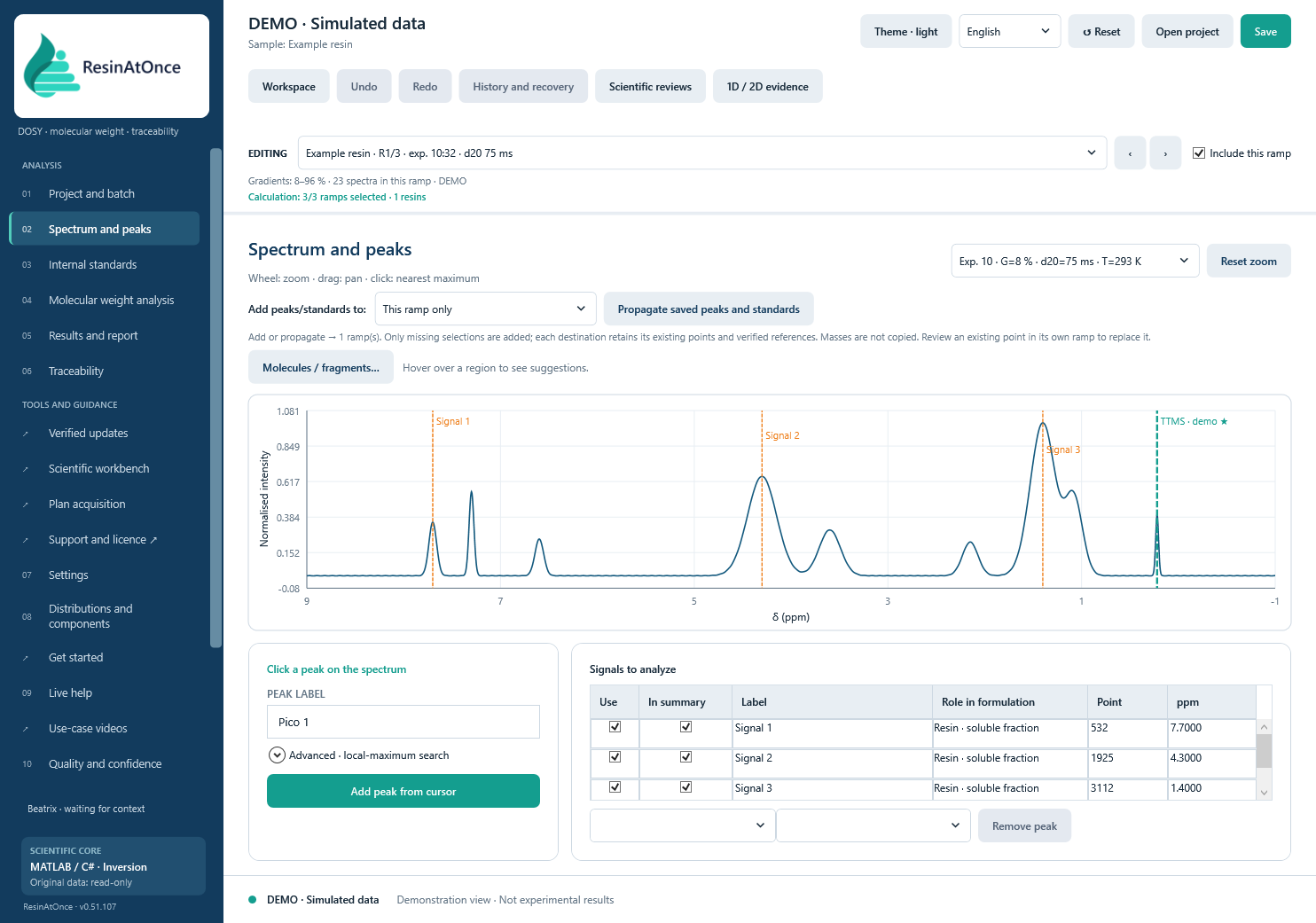
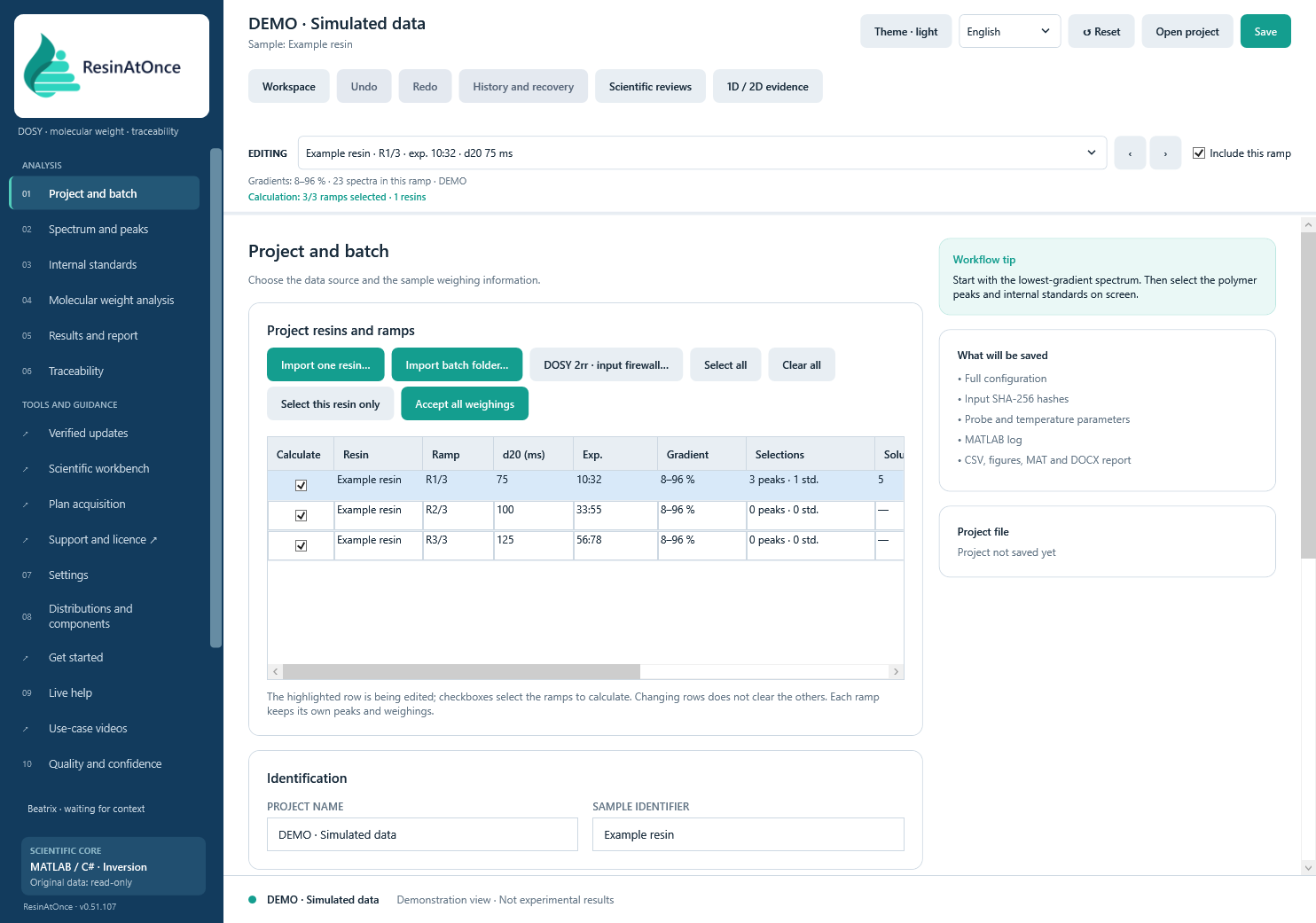
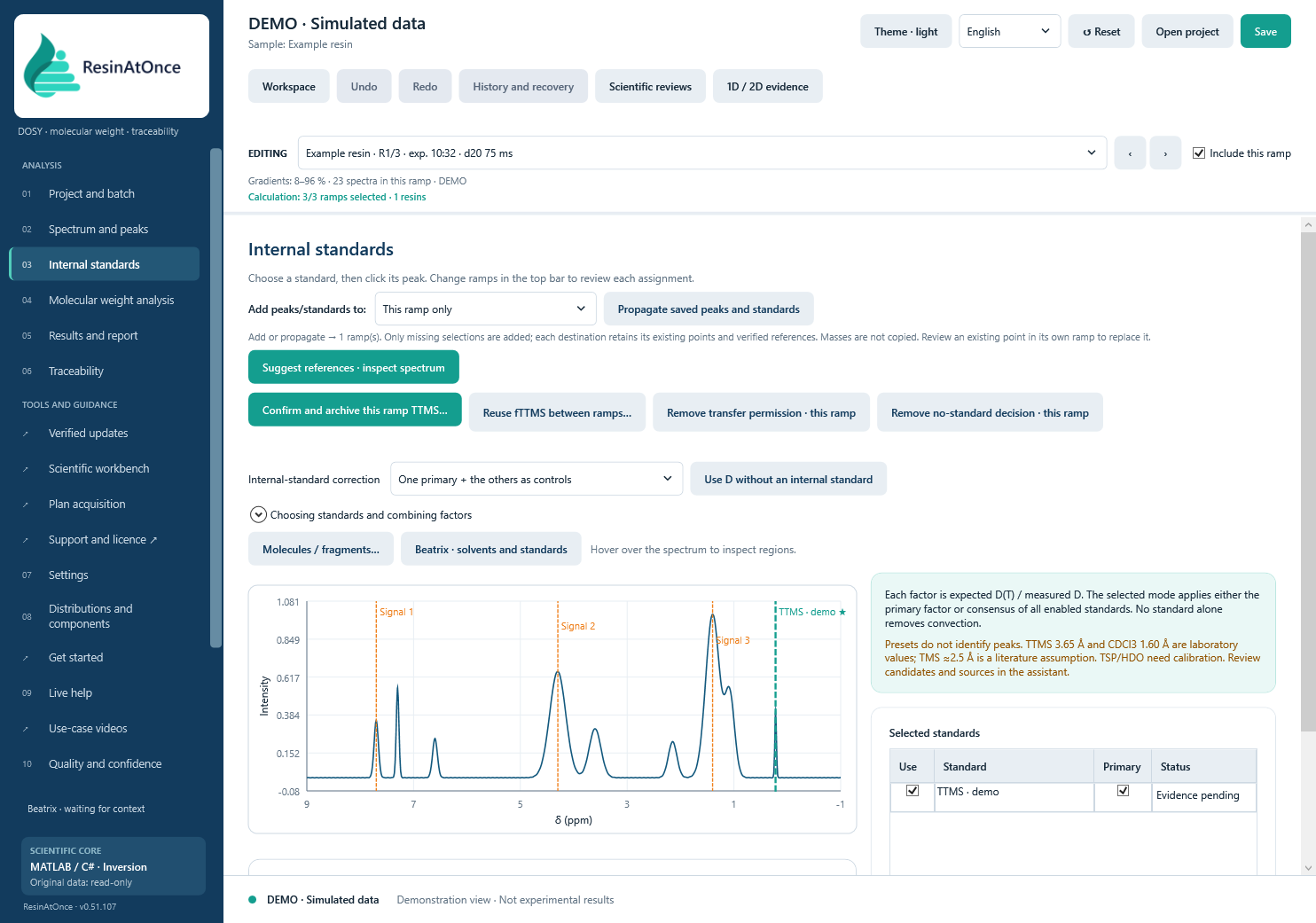
The dedicated resin application: spectra, ramps, internal standards, components, Beatrix and traceable results.

See application and screenshots ↗Windows · 0.51.116 · research

Studio brings together current Prime and ResinAtOnce installers and help. Downloading or installing does not replace each application’s registration or usage approval. Continuum has its own WPF and Web Local preview. DM is presented as a research product line and does not have a stable catalog installer.

Software, code and availability →

BEFORE ACQUISITION

Calibration has a workspace, too.

DiffAtOnce Spectrometer Calibration: guided instrument preparation, 90° pulse fitting and DOSY calibration with a standard. TopSpin interface, manuals and demonstration in Spanish and English.

Explore calibration and downloads ↗
01 Prepare02 P1 / 90°03 DOSY / bTopSpin · Jython · ES / EN

NEW TOUR / PRIME 0.15.121

DiffAtOnce Prime

Your diffusion workspace,
in one view.

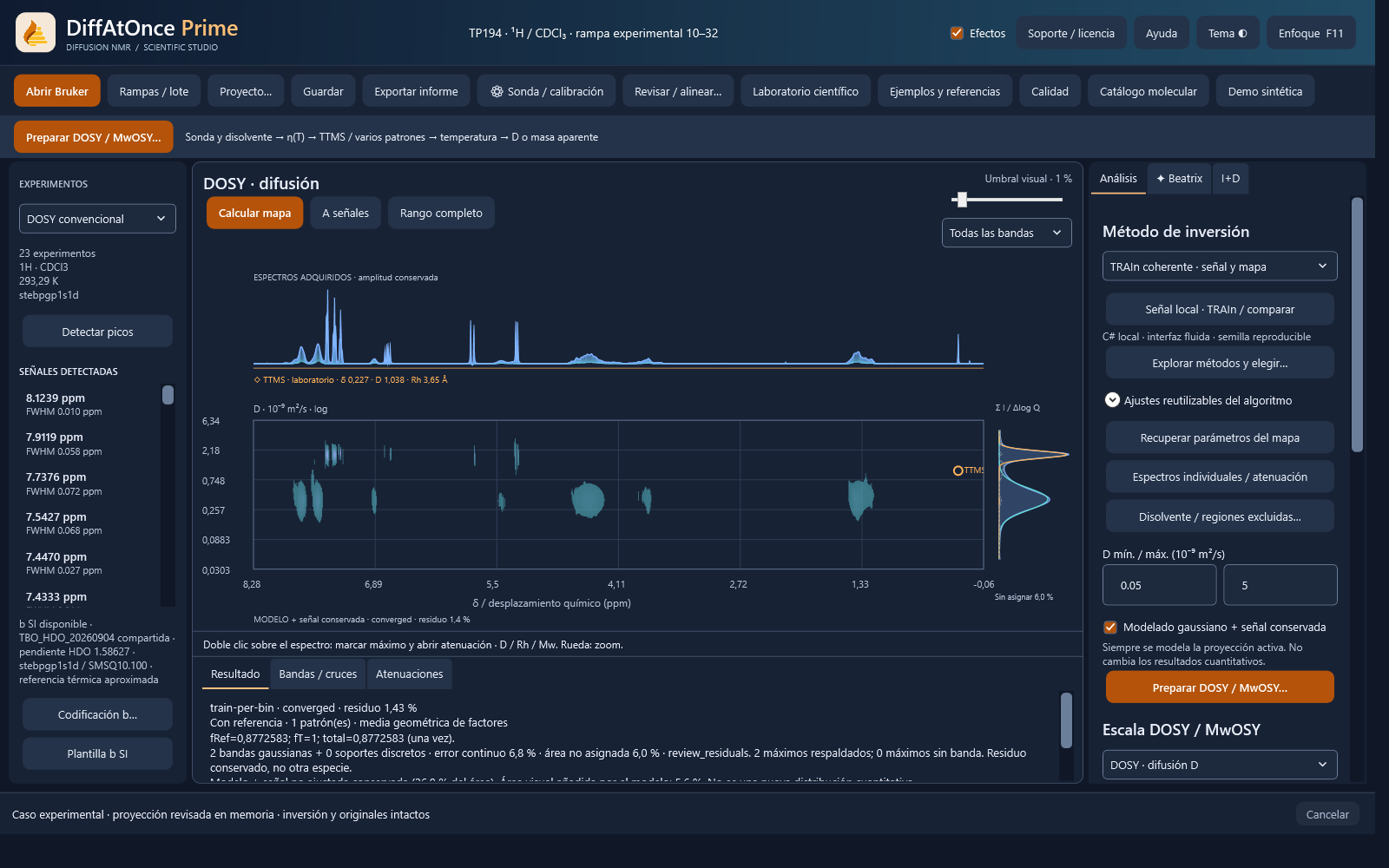
DOSY, MwOSY, attenuations, standards and Beatrix. Current experimental screenshots, ultrafast D–T₂ with TRAIn2D/FISTA, SPEN sources, a complete guide and FAQ.

Explore Prime →User guide →
Prime 0.12.5: saved experimental DOSY map in dark theme

DIFFATONCE LEGACY · 2.12.4

The original idea.
A renewed desktop.

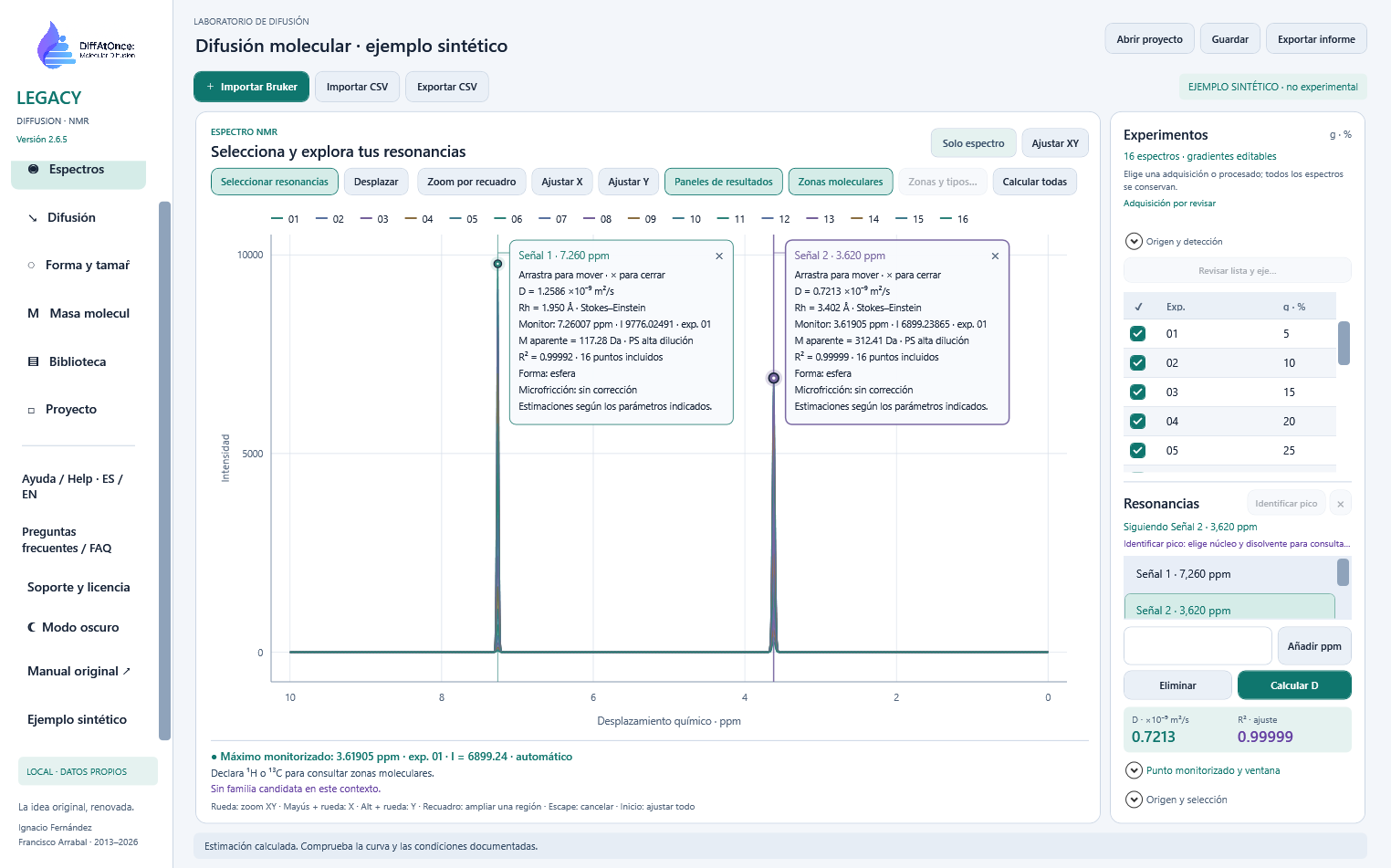
The spectrum at the heart of your work: track resonances, review ln(I/I₀), calculate D and Rh and explore shape and apparent mass. Probes and calibration, traceable projects and reports in a Windows WPF application.

  • Bruker 1r / 2rr and CSV · gradient ramps without fixed numbering
  • ES/EN guide with 18 topics and 24 questions per language
  • Light and dark · probe profiles · PDF, PS, EPS, Excel and CSV
A modernisation of DiffAtOnce by Ignacio Fernández and Francisco Arrabal. Estimates depend on reviewed models and conditions; it does not certify absolute masses.
DiffAtOnce Legacy 2.6.5: spectra and resonance results, synthetic light-theme example
Actual application · synthetic data from the included example.

FROM EXPERIMENT TO REPORT

Every decision, in view.

Diffusion NMR & DOSY guide →
  1. 01

    Import

    Spectra, ramps and acquisition parameters.

  2. 02

    Calibrate

    Probe, sequence, gradient, temperature and standards.

  3. 03

    Interpret

    ILT methods, distributions and molecular models.

  4. 04

    Document

    Results, decisions and traceable reports.

Real interface screenshot · Simulated data · Not an experimental result

Open original image in a new tab ↗

WATCH, PAUSE, REPEAT

Learn with workflow videos.

Six workflows with separately narrated Spanish and English movies, in the application and on the web. Page language selects the voice, interface and timeline; CC offers ES/EN captions. Chapters and downloadable steps. No autoplay or external providers.

Watch workflow videos →

DIFFATONCE LEGACY · WEB / WPF

Watch the workflow. Repeat each step.

Spectra and local maxima, calibration and R², diffusion, shape and reports. Six guides with narration, captions and chapters.

Watch the Legacy guides →

DIFFATONCE / MOLECULAR DIFFUSION

Your next question
starts in the spectrum.

Explore the DiffAtOnce family ↗